
Thirty bailiffs work at the Lancaster County Courthouse, myself included. Thirty people, retirees mostly, doing the all-rise thing on a part-time basis, after doing something else most of their lives.
So everyone has a backstory, and everyone has stories, period – none better than those offered by Joe Hockley, who spent 37 years in law enforcement and has been bailiff-ing for five. Time and again the 72-year-old will sidle up to one of us and say, “Did I ever tell you about the time …” And then he’s off, more often than not in the direction of a punchline.
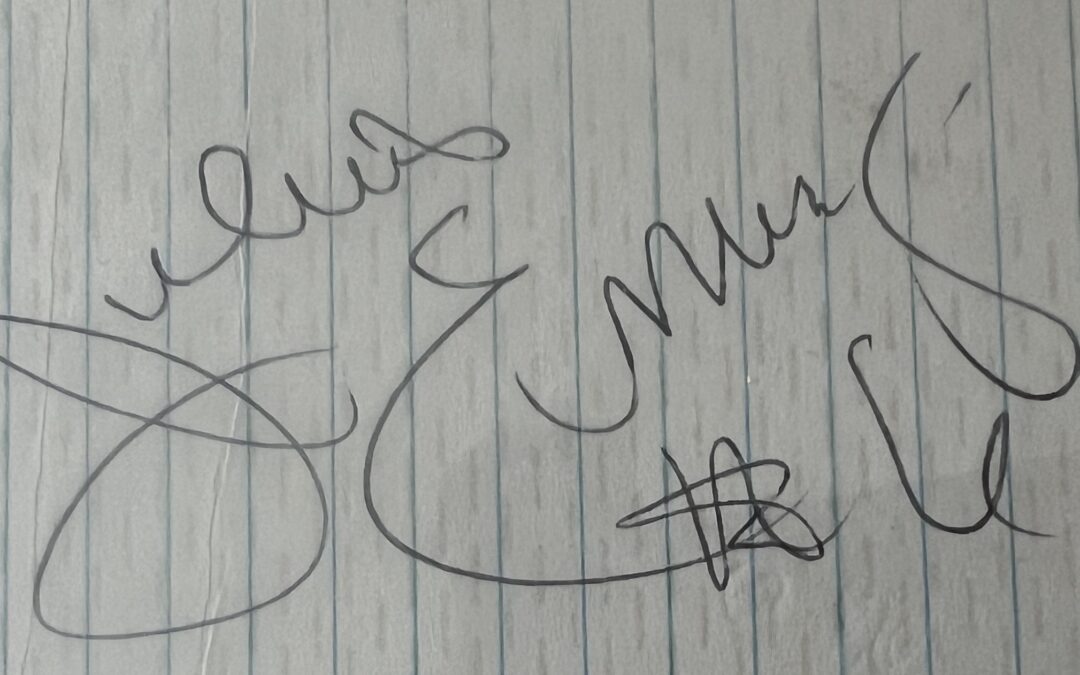
Which is how we got to talking recently about a notebook page he has kept for 42 years, and one he unearthed after rummaging through his attic the other day. Written upon it is the looping autograph of retired Sixers legend Julius Erving, as shown above, and it dates back to the fall of 1984, when the team held training camp at Franklin & Marshall College.
Hockley was three years into his career as a Lancaster City police officer when he was assigned to work security at camp one day that fall, a plumb gig that usually went to older guys. He was heartened by how friendly the players were, and marveled at their abilities during an afternoon scrimmage that was open to the public. (And indeed it is one thing to watch these guys on TV, quite another to watch them up close.)
When the scrimmage was over, Hockley’s supervisor asked him if he could hang around a little longer and work crowd control, as Erving wanted to sign autographs for the fans who had gathered. This was not unusual for Dr. J, even after two-a-days; indeed, few athletes have ever had a better grasp of their public responsibilities.
So Hockley stayed.
“I’ll sign these autographs,” he remembers Erving telling the throng, “but we’re going to have to do this in an orderly fashion. Just get in line.”
They queued up, and by Hockley’s recollection Erving signed for at least 40 minutes, and perhaps as long as an hour.
“He did the last one, and then turned around to thank me,” Hockley said, “I said, ‘Hey, could you do me one thing?’ I pulled my notepad out of my shirt pocket. ‘Could you give me an autograph?’ He laughed and he said sure.”
It would be correct, then, to say that the Sixers left their mark on the community, in ways great and small. There was a real connection to the team, which trained in Lancaster from 1978-94, a bond born of the fact that the Sixers were amid the greatest era in their history, and some other things, too.
They won the 1982-83 championship – their most recent title – after not only training here, but returning to Lancaster for a pre-playoff mini-camp. (Sunday marked the 43rd anniversary of the clinching victory over the Lakers in Game 4 of the Finals, nearly fulfilling Moses Malone’s fo’, fo’, fo’ prophecy.)
Two other teams, in 1980 and ‘82, used Mayser Gym as a launching pad to the Finals, and in all 12 of the 16 teams that visited reached the postseason.
But the connection wasn’t just a result of the Sixers’ success or star power. (Erving, Malone, Charles Barkley, Bobby Jones and Andrew Toney were among the big names to trek to Amish Country.) It was because locals could literally reach out and touch these guys. For a week every fall, fans packed Mayser to the gills, as noted in a recent LNP piece. They saw the team up close and personal.
They saw Erving and Moses doing their thing. They saw, as Hockley noted, Barkley cursing himself after missing free throws. They saw a precocious rookie guard named Sedale Threatt attempt to dunk on Malone during a scrimmage in the ‘83 camp – i.e., the fall after the title run. (Threatt, a sixth-round pick out of West Virginia Tech, wound up making the team. He went on to throw one of the most memorable punches in Sixers’ history, and played 14 NBA seasons for five clubs in all. When I asked him about that dunk attempt a couple years ago, he said, “When I got to the NBA, I had no fear. It was a routine thing for me, trying to dunk on guys.”)
There were quieter moments, too. During the inaugural camp in 1978 a reporter named Tim Mekeel gave rookie point guard Maurice Cheeks a ride back to the team hotel, during which Cheeks expressed concern about making the team. Mekeel talked him down, and in time Cheeks became not only a franchise fixture, but a Hall of Famer.
A few years later, Erving signed a new contract on the desk of F&M’s athletic director, Dr. William Marshall – or did so, at least, after Marshall cleared all the debris off the top of it. (Side note: Marshall’s son Kevin happily took on the task of delivering Cheeks a Coke after every afternoon practice, as the point guard had an insatiable sweet tooth.)
One last thing: Glenn Robinson, the Dips’ long-time head men’s basketball coach (now retired), once found himself drawn into a one-on-one game against Erving. You can no doubt guess how that turned out, though there is an amusing sidelight that will be shared in a moment.
The point is, this was an immersive experience for all involved. Literal giants walked among us. They would get their ankles taped in the F&M trainer’s room, next to fullbacks destined to be financial analysts and midfielders bound for careers in management. On some occasions those Sixers occupied beds in the school’s infirmary – or, at least, two beds pushed together, since one wasn’t enough to accommodate guys of their height.
It was a different time, to be sure.
The Sixers trained at Ursinus College before coming to F&M, but thought the synthetic surface then in use in Ursinus’ gym was too hard on the players’ legs. So they began looking around for another site. Marshall, now 88 and living with his wife Julie in a retirement facility outside Minneapolis, said in a recent phone interview that Pat Williams, then the team’s general manager, called at some point in 1978 and told him that they had investigated the facilities at Swarthmore, Lafayette and the University of Delaware, but heard good things about Mayser. Could they come check the place out?
Of course Marshall gave his assent, and not long after Williams drove with Erving to Lancaster. And as Marshall watched from the bleachers, Dr. J dribbled up and down the court a few times, and threw down a dunk or two.
“All of a sudden,” Marshall recalled, “he stops and says to Pat, ‘This is the place. No question – this floor is the best floor I’ve been on.’”
A few months later, the team arrived. Cheeks was a second-round pick out of West Texas State, and had heard what everyone else had heard – that the Sixers had tried to trade up in the draft to select Phil Ford, an All-American point guard from North Carolina. They failed to accomplish that – Ford went second overall, to the Kansas City Kings – but it seemed clear they weren’t ready to toss the keys to a rookie whose biggest claim to fame to that point was a star turn in the Pizza Hut Classic, a postseason all-star game.
Cheeks shared his concerns with Mekeel, then early in what would become a 44-year career with the Lancaster New Era. He’s 70 now and retired, and does not recall exactly how he wound up chauffeuring Cheeks back to the Treadway Inn (now the Eden Resort) in his 1965 Chevy Nova. Maybe, he said, the rookie simply missed his ride, and Mekeel’s car was “the vehicle of last resort,” as he put it.
When Cheeks wondered aloud about his chances of making it, Mekeel noted his positive attributes, starting with his defense. And indeed that would become Cheeks’ calling card over his 11 seasons with the Sixers, and his 15-year career. Well … that, and the fact that he protected the ball like a family secret. Oh, and reliably knocked down open 15-footers. And finished adroitly on the break.
(Worth noting: Phil Ford was the 1978-79 Rookie of the Year, and enjoyed three strong seasons before his career went south. He was out of the league by 1985. Cheeks made four All-Star teams and five All-Defensive teams in Philadelphia, and played through 1993.)
Erving’s resume need not be reviewed, and in another scene that was indicative of the times Williams was eager to get the Good Doctor’s signature on a new contract while the team was in camp one year. Marshall’s office seemed like as good a place as any to do that. One problem, though.
“There were papers all over the place,” Marshall recalled with a laugh. “I was not a very well-organized guy. But I knew where everything was.”
Williams asked him if he wouldn’t mind tidying up his desk, which Marshall did. And when Erving and the GM entered the room, the AD stepped out, understanding his own office wasn’t really his place to be for the time being.
“A short time later, they came out and Julius was all smiles,” Marshall said. “Pat smiled. He inked his anchor to a contract. That was an interesting case.”
So too was the time when Dr. J encountered Robinson in a downstairs hallway in Mayser between practice sessions.
“You bring your defense?” Erving asked.
And then the two of them repaired to The Pit, a basement gym featuring the same synthetic surface the Sixers had fled when they left Ursinus.
No matter; the future Hall of Famer and the guy destined to win more games than any other Division III men’s basketball coach began playing one-on-one. (Robinson could play a little – I still have the welts to prove it – but gonna guess Julius wasn’t quite going full speed.)
Robinson’s ball first. And he buried a mid-range jumper.
“You’re hangin’,” Doc said, meaning that he wasn’t releasing the ball quickly enough.
Make it, take it. And again Robinson scored.
“You’re hangin’,” Erving said once more.
On Robinson’s third attempt, Erving reached up and plucked the ball out of Robinson’s hand, as a civilian would a jar off a supermarket shelf.
And that, as they say, was that.
The years passed. The Sixers continued coming to F&M, even as the team’s fortunes waned following Erving’s retirement in 1987. It’s noteworthy that Robinson’s players would routinely serve as attendants during camp, mopping up wet spots during scrimmages, fetching towels and performing other menial tasks.
One of those to fill this role was Chris Finch, a two-time D3 All-American for the Diplomats who is now the coach of the Minnesota Timberwolves. He told me last year he doesn’t remember much about his brief association with the Sixers, beyond the time he walked past the trainer’s room and overheard Barkley and Rick Mahorn holding court.
“Put it this way — I’m not sure they stayed in Lancaster,” Finch said with a laugh. “I don’t think they had their evening fun in Lancaster. That’s the only memory I have.”
The Sixers moved camp to the University of Delaware in the fall of 1995, and in subsequent years would go to places like Duke, Penn State, The Citadel, Fort Collins, Colo., and the Bahamas. Nowadays they confine themselves to their practice facility in Camden, NJ.
A pity, because there was something a little different about them holing up way out here in the boonies, as Barkley once described the area to me. Something kinda special about the connection that was forged. Certainly the Sixers made their mark, and not just on Joe Hockley’s notepad. And certainly that won’t be forgotten any time soon.