
Few public figures have been chronicled more extensively and elegantly than Muhammad Ali. Whether via short form (like “Lawdy, Lawdy, He’s Great,” an account of the Thrilla in Manila by the late Mark Kram in Sports Illustrated) or long form (like Jonathan Eig’s 2017 biography “Ali: A Life”), The Greatest has always inspired literary greatness. We’re talking all the heavy hitters. Norman Mailer. David Remnick. Dave Kindred. George Plimpton. Thomas Hauser. All of ‘em.
Often mentioned in those works is that Ali trained for the better part of a decade in Deer Lake, in Schuylkill County. Indeed, no fighter has ever been identified so closely with a camp as Ali.
That might seem incidental, but Todd Mealy strongly believes it is not. Mealy, who coaches McCaskey’s football team (after previous stints at Penn Manor and Lancaster Catholic), launched his latest book, “Fighter’s Heaven: Inside the Camp Where Muhammad Ali Remade His Legacy,” on Saturday in Deer Lake. And during an appearance last week on “After the Buzzer,” a podcast I co-host with Mike Gross, he argued that the camp is the reason Ali became “one of the most admired people on Earth.”
And that, Mealy added, is “because he makes himself accessible to everyone, and he wins people over by having them get to know him.”
The 47-year-old Mealy, a self-described academic writer, has authored or contributed to 13 books, many of them centered on civil rights. His latest work grew out of a piece he did about the camp for Pennsylvania Heritage magazine in 2020. In the book he points out that Ali was a reviled figure when he returned from a three-and-a-half-year exile, the result of his conviction on the charge of draft evasion. (“I ain’t got no quarrel with them Vietcong,” he memorably said at the time.)
Draft-dodging was a no-no in the minds of many at the time. Same for his earlier conversion to the Muslim faith. Mealy points out in the book, as he did during Saturday’s launch, that most journalists insisted on calling him Cassius Clay, even after he converted. Only over time did that change.
All those things continued to swirl about Ali, even as his career resumed in 1970, when the conviction was overturned on appeal and his boxing license was restored. After a few fights, notably his ‘71 loss to Joe Frazier, he began seeking out a permanent training base, having previously trained at Angelo Dundee’s Fifth Street Gym in Miami.
Ali’s inspiration for having his own place arose from a brief stay years earlier at a California camp run by another fighter, Archie Moore. Ali’s interest was further piqued by a visit to a youth camp opened in New Jersey by one of his teammates on the 1960 Olympic team, a pole vaulter named Don Bragg.
The idea was not only to find a spot where he could buckle down and concentrate, but also a place that could serve as a long-term financial investment. Ali was pointed in the direction of Deer Lake by his business manager, Gene Kilroy, a Mahanoy City native. For a time in 1972 Ali lived in a trailer on a mink farm owned by Bernie Pollack, who doubled as a boxing manager. There he could do his road work in peace while training at the Reading PAL, but he sought something more.
That led him later that same year to purchase two acres on Sculps Hill from Pollack. Mealy writes that the land is actually in Orwigsburg, but Kilroy insisted that they call it Deer Lake, because it sounded “more romantic.” And so it forever remained.
The place started out with a gym, mess hall and bunkhouse, and later expanded to include several cabins, and finally a mosque. As Mealy points out in the book (and in our conversation with him last week), Ali’s presence could have been problematic; white supremacists had their own place just two miles away.
But trouble never arose, and in the author’s estimation that was because of Ali. He welcomed visitors to his workouts. He mingled with onlookers, did magic tricks for youngsters, signed autographs. He also ventured out into nearby communities, to Little League banquets and the like. There was no divide, no distance.
During a Q&A session with several visitors Saturday, Mealy said he and his wife Melissa, principal at Eshleman Elementary School in the Penn Manor District, often pose a question to their children: Carter, 12, and Adeline, 9: “What are you doing to make people’s lives better?”
Mealy put it another way to me in a conversation later that day: “As an individual, you want to learn something new and you want to lessen the suffering of others. That’s Ali’s signature thing.”
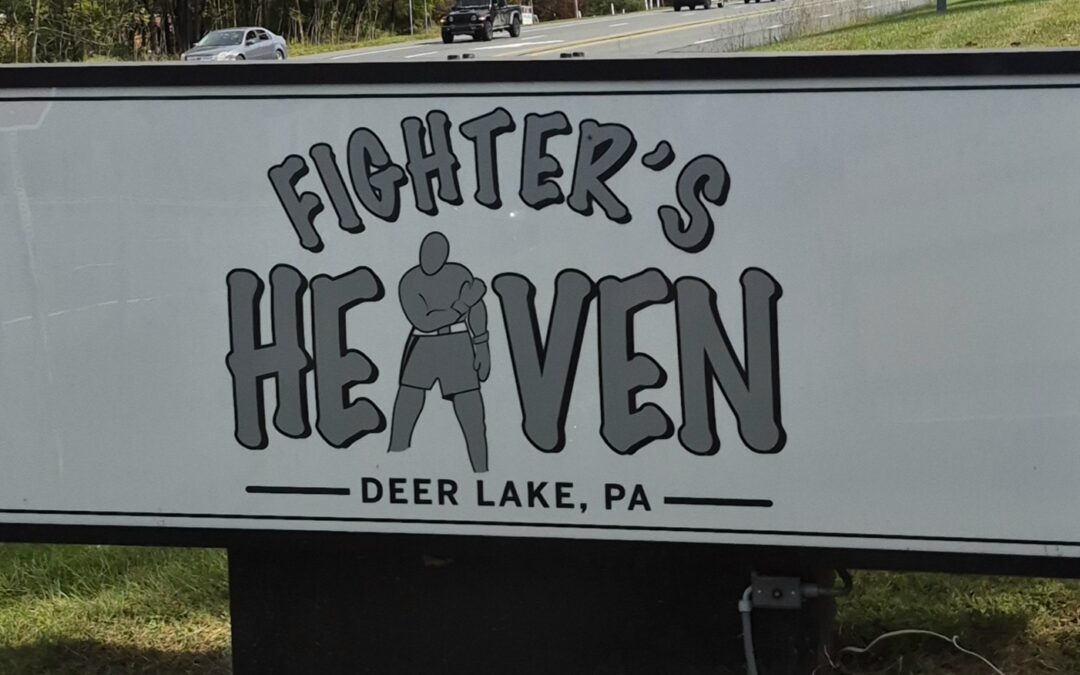
So Deer Lake became his platform. It came to be known as “Fighter’s Heaven” at the suggestion of a former boxer named Charles “Mickey” Thomas, a friend of Ali’s. That it was singular – apostrophe … s, as opposed to s … apostrophe – was a mistake, but then again, maybe it shouldn’t be viewed that way, seeing as the place became synonymous with the pugilist.
Ali last trained there in 1980, for his next-to-last fight – a loss to Larry Holmes, his former Deer Lake sparring partner – and according to Mealy’s research last appeared there in 1991. The camp was left lying dormant for years before Mike Madden, son of the late, legendary broadcaster John Madden, bought the property following Ali’s death in 2016. The younger Madden sought to restore it to the way it looked when the fighter trained there, and appears to have largely accomplished that, while at the same time giving it a museum feel; the gym features dozens of photos, posters and the like.
Mealy has likewise resurrected that time and place in his book, through dogged research and precise writing. He told a story Saturday about asking Kilroy the names of the horses Ali rode while at Deer Like. And Mealy did so while he and Kilroy were driving in Las Vegas.
Kilroy screeched to a halt.
“Why would you want to know something stupid like that?” he asked, throwing in a few expletives for good measure.
Here’s why: Because the devil is in the details. Because they are the essence of good writing. Because they make the text richer and more complete. In this book, for instance, you will read that Ali had a van called “Foolin’ Around.” That Ferdie Pacheco – the Fight Doctor, as he came to be known – once called Ali “a pelvic missionary” because of his sexual exploits. And that the presence of a sign in the Deer Lake kitchen nearly led to a lawsuit.
(Also: The horse’s names were Kentucky, Gypsy, Missy, Cochise, Foxy Tom Tom and Snoopy. Mealy learned that not from Kilroy, but from others.)
The bottom line is that Mealy has done his homework. He was the one grinding away on this project the last three years. The one sitting on a folding chair at his kids’ practices for various sports, having opened up a hotspot on his phone and a long-ago story on Newspapers.com.
Tedious work, but well worth the time, given the book he has produced. What he did, really, was take a left turn off Route 61, venture up Agony Hill (as Ali called it) and explore a place in which even the heaviest of literary hitters only briefly set foot. As a result he found aspects of Muhammad Ali’s tale, as oft-told as it has been, that nobody else found.