
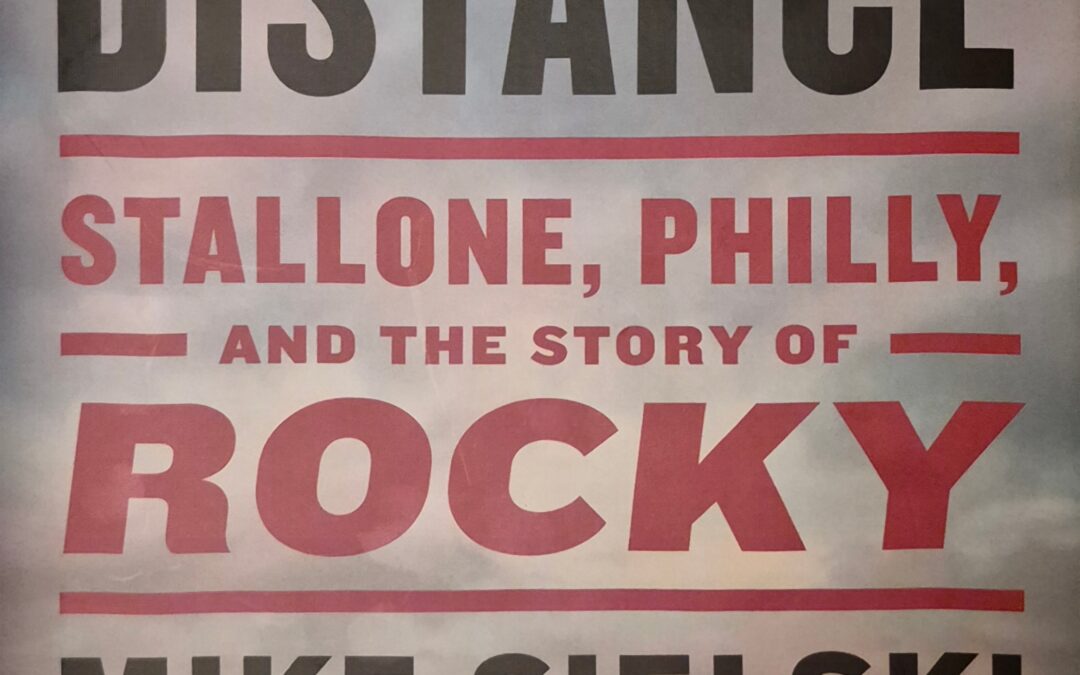
At the launch last Tuesday of his new book “Going the Distance: Stallone, Philly and the Story of ‘Rocky,’” Philadelphia Inquirer sports columnist Mike Sielski told a gathering at the Doylestown Bookshop that it should come as no surprise to anyone if he is seen out on the sidewalk, wearing sandwich boards to promote his latest offering.
He was kidding. Mostly.
Sielski, author of four other books, has discovered that the actual writing is only half the battle in this day and age – that it is also imperative that someone in his position bang the drum, consistently and insistently, in order to draw readers’ attention.
That’s especially true in the case of this book, which arrives on the 50th anniversary of a movie that won an Academy Award for Best Picture and resonates still – especially in the Delaware Valley.
It’s why he also made appearances last Tuesday on Fox News Radio and WHYY’s Studio 2 podcast. Why he shot an Instagram video the following day with Frankie Olivieri, owner of Pat’s Steaks, and did an interview with 6ABC’s Tamala Edwards at the Italian Market. Why he sent an autographed copy to Tony Kornheiser, co-host of ESPN’s “Pardon the Interruption,” in the hope that it would appear on the air behind Tony. (Spoiler alert: It did.)
It’s also why Sielski was hawking books from a booth at Saturday’s Rocky Run, an event that attracted an estimated 40,000 participants and featured races of three different distances. And why he will do an interview with WIP’s Rhea Hughes at Laurel Hill Cemetery, the fictional resting place for two of the movie’s characters, Rocky’s wife Adrian (Talia Shire) and her brother Paulie (Burt Young).
Understand that this is not something that comes easily to Sielski, or any journalist worth his or her salt. We are not the story. Not supposed to be, anyway. But Sielski, 51, discovered after releasing his two previous books – “The Rise: Kobe Bryant and the Pursuit of Immortality” (2022) and “Magic in the Air: The Myth, the Mystery and the Soul of the Slam Dunk” (2025) – that publicists for publishing houses are interested in only doing so much, that the author must do the bulk of the promotional work.
“It occurred to me finally – I don’t give a shit about whether people think I’m talking about this book too much,” he said in a phone interview last Wednesday. “You can’t think about it in those terms, and it’s really terrible, and it’s totally self-serving and totally gross. But I’m not going to stop. It’s like trying to light a stubborn match. You don’t know when it’s going to spark, or if it’s going to spark. And the worst thing you can do is stop trying.”
So he’ll keep grinding, at the risk of having his last name butchered, as was the case during a recent appearance on The Writer’s Bone podcast; host Daniel Ford repeatedly called him “Saleski,” as if he were related to Don Saleski, the long-ago Broad Street Bully.
Full disclosure time: I’ve known Mike forever, and very much respect him and his work. Also, I’ve just started reading the book, so I can’t give a full assessment of it. But I’ve liked what I have read to date, and have also enjoyed the excerpts, like those that have appeared courtesy of the Inquirer, Philadelphia Magazine and Slate.com.
The last of those is particularly interesting, as it hints at the depths of Sielski’s reporting – and the apparent lengths to which the film’s star, Sylvester Stallone, has gone over the years to propagate certain myths. According to the book, a cash-strapped Stallone has often said he sold his bullmastiff, Butkus, to a man named Jimmy Gambina, who actually trained Stallone for the film’s boxing scenes and appears on screen as an assistant to Rocky’s trainer, Mickey (Burgess Meredith).
After Stallone succeeded in peddling his script to United Artists, he wanted to buy Butkus back. It is his oft-stated claim that Gambina had the pooch for just a week, and that he held out for more money, as well as a role in the movie. Sielski, having interviewed Gambina, debunks all of that in the book. He writes that Gambina had the dog for nearly three years – that Butkus had in fact become the family pet, and that it has “broken (his) heart” to be portrayed as the villain.
“I hope (Stallone) understands people appreciate his story,” Sielski said. “It is truly miraculous. You don’t need to puff up the myth, because it led him to say things that aren’t true.”
Sielski undertook this project two years ago at the behest of his editor. Even as he was covering the Eagles in the run-up to their Super Bowl victory over Kansas City in February 2025, he took time out to drive from New Orleans to Baton Rouge. There he examined the notes donated to LSU by Bill Conti, an alum of the school and the composer of the film’s score.
Think about that a moment – Sielski held in his hands the sheet music for the movie’s stirring theme song, “Gonna Fly Now,” complete with the notations Conti had scribbled in the margins. Where authors are concerned, it doesn’t get much better than that.
“It’s a very good movie without the music,” Sielski told the crowd at last week’s launch. “The music takes it to a place that’s transcendent.”
He called his two interviews with Conti the most enjoyable part of the reporting process. Reaching Stallone, on the other hand, proved challenging. At first Sielski thought he could complete the book without interviewing the film’s star – that he could rely on the many interviews Stallone has done over the years. But the more he discussed his project with others, the more he was asked whether he was going to get Sly.
Sielski finally obtained Stallone’s email address, but didn’t hear back when he reached out to him. That led to a discussion with the film’s executive producer, Gene Kirkwood – “a real Rat Pack kinda guy,” according to Sielski. (“I’ve never been called ‘Babe’ so much in my life,” he added.)
Kirkwood said Stallone was a fan of legendary New York City tabloid writers like Pete Hamill and Jimmy Breslin, and suggested that Sielski mention them in his next missive. So he informed Stallone the book was going to be written in the style of those greats, and sure enough, the actor responded instantly. In all they corresponded four times, and Sielski said Sly’s responses were “as raw and as real” as anything that appears in the actor’s recently released memoir, “The Steps.”
Sielski has teased some other things that appear in his book, which is not affiliated in any way with the new movie “I Play Rocky.” One is the fact that when Carl Weathers, a former NFL player, auditioned for the part of Apollo Creed, he removed his shirt. Stallone felt compelled to do the same.
“It gets to the point,” Sielski said at the book launch, “where they almost come to blows. That’s where they figured Carl Weathers was the right guy for the part.”
The film is also one of the first to make use of the Steadicam, which had been invented in 1972 by Philadelphia cinematographer Garrett Brown. It allows camera operators to shoot while on the move, without fear of the video being impacted by the resultant jostling. And it is most breathtakingly employed in the scenes where Stallone runs up the steps of the Philadelphia Art Museum.
One last thing: Sielski visited with long-retired boxer Chuck Wepner (a.k.a., “The Bayonne Bleeder”), whose 1975 bout against Muhammad Ali has long been believed to be the inspiration for the film. Wepner went so far as to sue Stallone for royalties, but according to Sielski regrets having done so. The other notable thing about his interview with Wepner, Sielski said, was the request of the former boxer’s wife, Linda. Should his book ever be turned into a movie, she asked that Jennifer Lawrence play her.
For that and many other reasons, the author called the book “a blast to do.” It culminated with the recent arrival of the books at his suburban Philadelphia home. And that, he told me, is “what makes everything worthwhile.”
Pause.
“And,” he added, “I’m kicking myself. There’s like a very minor mistake or two in the book, and I’m beating myself up over that. You want it to be perfect. You know the feeling.”
Too well. Writers are, after all, a neurotic tribe. And as he has learned, we are now a tribe that must venture outside our teepees, outside our comfort zone. More tooting of one’s own horn is necessary. More shouting from the rooftops. These days, it’s the only way anyone can really go the distance.