
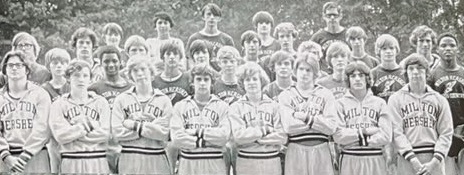
Nobody rides the bench on a high school cross country team. There are no reserves, no backups, no scrubs. Everybody runs, in every dual meet. Everybody competes against the opponent, the clock, themselves.
That said, you don’t have to be Steve Prefontaine to ascertain a team’s pecking order. Here I’m reminded of something Pat Williams, the late Sixers general manager and a guy with whom I once collaborated on a book about the team, used to say on his voicemail message. And that was this: A track coach has it easy, since all he has to tell his athletes is, “Stay to the left, and be back soon.”
(Insert rimshot here.)
Track, cross country – same principle. We all know who’s leading the pack, who’s returning soonest.
Which is why I was left with a case of Imposter Syndrome last week, when the 1975 cross country team from my high school, Milton Hershey, gathered to be inducted into the school’s Hall of Fame.
I mean, seriously, what the hell was I doing there, a half-century after the fact? I was nothing more than a middling runner on a team that was amid a run of 61 straight dual-meet victories. That ‘75-76 school year – my senior year – was the only one in which I competed, and I made no appreciable impact.
But as my wife Barb pointed out, of course I should be there. I was on the team. And as I reminded myself, if I didn’t make an impact on it, it certainly made an impact on me.
I was one of nine guys to show up, from a team featuring over 30 runners, according to the team picture shown above. (That’s me in the second row, third from the right – with hair!) The guy all the way in the back with the glasses is the coach, Ed Ruth. He started the program in 1967, as he told me over the phone a few days before the ceremony. He would later found the girls’ program when MHS went coed, a year or two after I graduated. (And don’t get me started on that, lol.)
Ed was a biology teacher when I was there, and in all spent 38 years at the school, in various positions. What I didn’t know then (because knucklehead teenagers don’t care about such things) is that he’s a Lancaster guy, having graduated from McCaskey in ‘61. He ran there and at Lebanon Valley College before getting into teaching and coaching.
I remember him as an exacting guy, a guy who before I ever ran for him summoned every honor-roll student at the school to the auditorium one lunch hour, for reasons that were initially unclear to us. Once there, he encouraged all of us to come out for his team, because he was tired of dealing with runners who wound up academically ineligible.
He was also a guy who followed his practice plans to the letter – over-distance one day, interval training the next, etc. – and worked on our heads as well. He would remind us that Jeff Tomecek, our best runner, might (god forbid) roll an ankle during a meet. Or that someone might be disqualified. So the idea was to run your best race, every time out. Control what you can control. Because you just never know.
(I will say this, though: Because of the nature of our home course, there were those who would hide in the bushes and not run the pony path, the hardest part, during certain workouts. Then they would re-emerge from their hiding place at around the spot where they figured to be in the conga line, and finish things out. Far as I know, Ed was never the wiser.)
He’s 82 now, and as luck would have it has settled with his wife Betsy into a retirement community not far from my home. Unfortunately he was unable to make it to the ceremony because of illness, but said he had his remarks all teed up. Given his gift for preparation, that surprises me not a bit.
Tomecek (the guy standing right in front of me in the photo) was there, and that was a good thing. Gifted runner. Finished 10th in the state in ‘76. (He covered three-mile courses in around 15 minutes. I was in the 18s, meaning I was literally a half-mile behind him when he crossed the finish line.)
For all his ability, Jeff was always gracious and humble – not an easy thing for a young guy – and hasn’t changed a bit. So that was refreshing to see. And it was good to touch base with Mike Halbleib (the other guy standing in front of me, looking off to the side for reasons that are unclear now, even to him); he now goes by Jerome Michael Halbleib, and has made his mark raising jumping horses. Among the others on hand was Andy Cogdell, a retired attorney.
I didn’t mention to them that one of my abiding memories from that year was a meet in which I was attempting to negotiate the aforementioned pony path – a sharp downslope to a muddy basin, leading into a steep uphill climb – and having both shoes sucked off in the ankle-deep mud, as others sped past. Nor did I bring up my abiding regret.
That was this: Had I joined the team a few years earlier, I’m convinced I could have been one of the better runners. Maybe not as good as Tomecek, but pretty good. The flip side is that running has become a lifetime sport for me. I still run 20 miles a week – albeit slowly – with the goal of 1,000 a year. (I currently stand at 895 for this year, so barring injury, I should once again make it.) Would that be the case if I invested the time and energy that I would have needed to invest as a high school freshman and sophomore to rise up the food chain? Maybe not.
What I do know is that running has proven to be as good for the mind as the body, that I solve a lot of problems when I’m grinding out the miles. That it brings me a sense of peace I might not know otherwise. So I’m going to keep going, keep running my best race – even if it’s only against myself. Just as Ed always told us to do, all those years ago.